Points of Sail: The Compass Every Sailor Steers By
Ask where a sailboat is going and a sailor answers with an angle: not "north," but "close-hauled" or "on a broad reach." The points of sail are the compass of the sport — directions measured not from the pole, but from the wind.
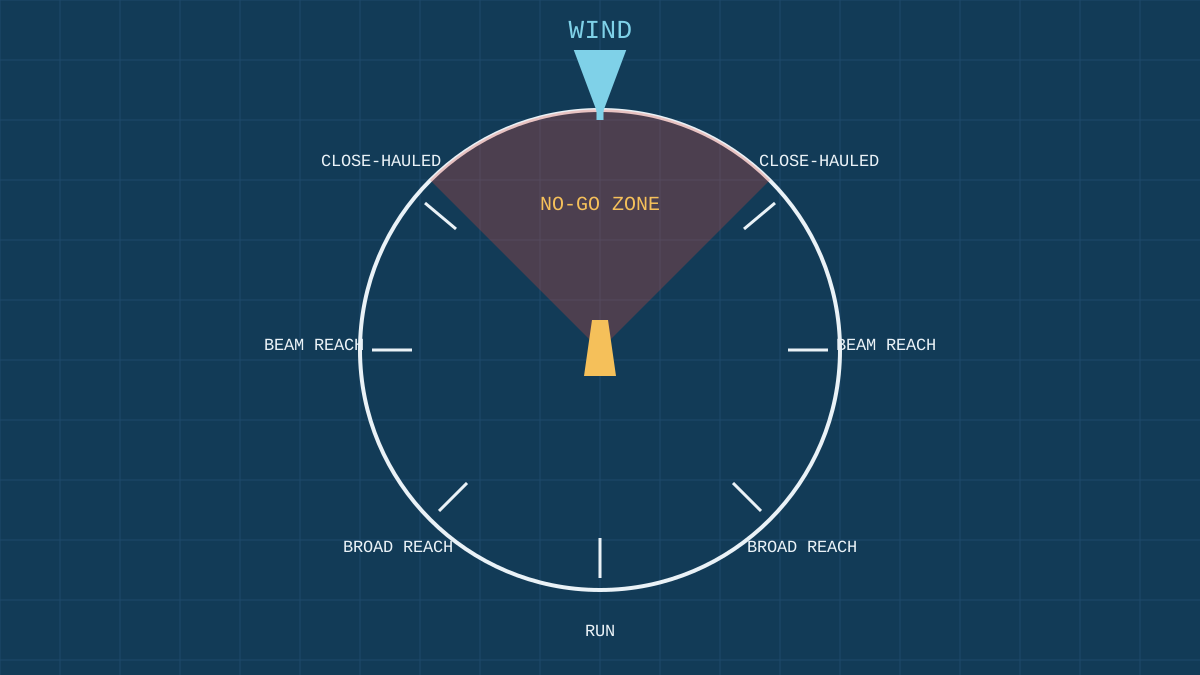
The forbidden zone
Straight upwind lies the no-go zone, roughly 45 degrees either side of the wind's eye, where sails flap uselessly and the boat stalls. Pointing there is called being "in irons" — a phrase from square-rigger days that still describes the same helpless flutter. Everything in sailing happens around this forbidden slice.
Close-hauled: the uphill climb
Sheeted hard, sailing as near the wind as she can, a boat is close-hauled — heeled, wet, and working. This is sailing's uphill gear: slow over the ground toward the destination but the only way to get upwind, tack by tack. Racers live here; cruisers endure it.
Reaching: the fast lane
Turn away until the wind comes over the side and the boat is reaching — close reach, beam reach, broad reach as the angle widens. The beam reach, wind square over the side, is most boats' fastest and easiest point: sails half eased, deck level, speed free. When sailors daydream, this is the angle they see.
Running: downhill with care
Nearly dead downwind is a run: sails eased right out, the boat upright and quiet — deceptively relaxing. The hazard is the accidental jibe, the boom slamming across if the wind sneaks behind the mainsail; crews steer attentively or rig a preventer line. Racing boats often avoid the true run entirely, zigzagging downwind at hotter, faster angles.
One diagram, whole sport
Draw a circle, mark the wind at the top, shade the no-go slice, and label the angles — that single diagram contains trimming, tacking, jibing and course strategy. Every maneuver in sailing is just travel between points of sail, with the sails re-tuned for each new angle.
Conclusion
Learn the points of sail and the wind stops being weather and becomes a map. Every sailor since the first one has steered by it.
Sources & Further Reading
- International Maritime Organization (IMO): imo.org
- US Coast Guard Boating Safety: uscgboating.org
- National Maritime Museum collections and references